
Thursday, June 17, 2010

Jean-Claude Vannier - L'enfant Assassin Des Mouches (1972)


I have a sneaking suspicion that there are other reviewers here better suited to review this album, but I've been listening to it for the last few days and figured I'd give it a shot.  This is the 1972 debut album by Jean-Claude Vannier, a musician and composer responsible for the orchestration on Serge Gainsbourg's Histoire de Melody Nelson, which had been released the previous year.  On L'enfant Assassin Des Mouches, Vannier crafted a grandiose and sprawling epic, one that begins with engaging and catchy instrumental rock compositions, yet frequently (particularly in the second half) moves in unusual, avante-garde directions.  This lack of cohesion, (I'm assuming) reflective of a desire to showcase his range as a composer, reminds me of Goblin's soundtrack work, albeit with real instruments rather than synthesized ones.  And like Goblin, Jean-Claude Vannier's music walks the line between playfully light, and epically pompous.  For me, the album feels directionless after the first few songs, but that may be simply because the first songs are very gripping, and I hadn't anticipated the somewhat more sombre and experimental tone the rest of the album would take.  I don't really see it as a problem- the less melodic stretches are interesting as well- but it does give the album an odd and disjointed flow, overall.

UPDATE:
Els (of breadxbread) brought this excellent Jean-Claude Vannier and Yves Saint-Laurent video to my attention:

Sunday, March 28, 2010

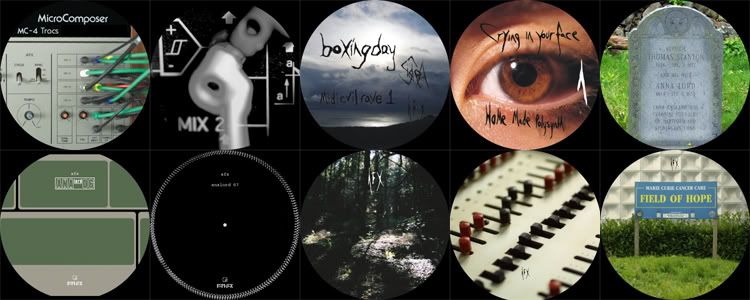
AFX: Newly Released Analords (2010)


It's not entirely clear if these Analord tracks were recorded with the originals or more recently. Probably the former given the fact that they were part of a re-release of all the previous Analord EPs which happened last December, but still surprising given how much some of them stand out in comparison to some of those original tracks.

The Analord series, as far as I can tell, was a way for Aphex Twin to experiment with format. After DrukQs, he had made as intense and furious an electronic piece of work than anybody could make, so it makes sense that he would decide to simplify in a certain way.

As much as some of the Analord tracks seem like merely musical gestures as opposed to complete songs, the word simple or simplify doesn't really do them justice. Part of what makes Aphex Twin such an amazing artist is not just the basic composition of the music, but the texture and personality of the sounds he uses. As far back as anyone can trace his work, his songs have always had a very special emotive quality, and an incredible range within that as well. The Richard D. James album as an example is full of memorable moments. Moments that exude some pretty raw emotions for an electronic album: bliss, sadness, detachment, frenzy, and a hundred other unspeakable qualities. The stuff he creates is like a language unto itself, a form of musical expression that can't be described completely with words. And that is a quality I hold dear in the world of music. It's something that has stayed true throughout his career, including what he's done with the Analord series.

Obviously, not every song he creates is on that incredible level, but his overall body of work is worthy of that. He's broken barriers that allow you to judge his work in a context that you would not allow any other artist; he's truly set himself apart. And that makes it easier to appreciate the 'simpler' tracks as more than just a lazy experiment.

The tracks I chose as examples, these 'Chosen (by RAW 3) Lords' are actually the least simplistic of the bunch. They are the standouts with the most personality, the most highly developed. Anyway, here they are. Buy them here: www.rephlex.com.

These are a really sweet addition to the whole series, they round it out very nicely and give it a little more depth of personality. Now, hopefully my daily prayers will be answered when he actually releases an Aphex Twin album on Warp this year. One can only dream...

AFX - Love 7 by elpretentio2

AFX - In The Maze Park by elpretentio2

AFX - 3 Notes Con by elpretentio2

AFX - Stabbij by elpretentio2

Wednesday, March 24, 2010

daughters - daughters (2010)


When I heard the first Daughters album, "Canada Songs", I was floored.  Released on Robotic Empire in 2003, at the height of popularity for grind and hardcore bands like The Locust and The Blood Brothers, Canada Songs was eleven minutes (!!!) of pure fury and funny song titles ("I Don't Give a Shit About Wood, I'm Not a Chemist").  And yet my shocked reaction to "Canada Songs" paled in comparison to how blown away I was by their 2006 follow up, "Hell Songs".  Over twice as long as "Canada Songs" (twenty-three minutes, this time!), "Hell Songs" featured longer song lengths, added instrumentation (members of progressive metal band Kayo Dot guested), and most notably, a new and demented singing style from Alexis Marshall; no longer screaming incomprehensibly, but rather drunkenly crooning, coming off like a satanic preacher (or "the sound of Elvis Presley being tortured", sez the Wikipedia page).  The woozy, off-balance vocals stumbled and ranted over the top of guitar squiggles and pounding drums, and the result was one of the most hateful and yet enjoyable albums I've ever heard.  A fitting movie (or comic book if yr a geek like me) comparison to "Hell Songs" might be the Joker: unhinged, violent and unpredictable, yet powerful and entirely in control at all times.  Suffice to say, I had high hopes for the new, self-titled Daughters album.  But when I put on "Daughters" for the first time, it became apparent that the stylistic leap that had occurred between "Canada Songs" and "Hell Songs" was not going to occur again.  Largely in the same vein as "Hell Songs", "Daughters" features slightly longer songs and more of the same crazed singing and technical guitar playing.  Yet somehow it wasn't the same as "Hell Songs" to me... it was lesser.  It took me awhile to fully grasp it, but the band significantly dialed back the intensity on "Daughters".  Rather than pummeling, full-throttle drums, the beats on most of the songs hit hard yet rarely let loose.  A thick synthesizer has been brought in, playing melodic lines alongside the guitar.  The songs are more hooky too, a little bit more accessible sounding.  If "Hell Songs" was Heath Leger's Joker, a violent psychopath, "Daughters" is a little bit more like Jack Nicholson's Joker.... similar, yet not nearly as threatening.  Kind of goofy, actually.  What happened?  Sometime between the time that this album was recorded last year, and its release this year, both guitarist Nicholas Sandler and bassist Samual Walker left the group, effectively breaking up Daughters and making this their final release.  This suggests that perhaps the band wasn't really working cohesively and toward a common purpose on this album, but then that's just speculation on my part.  Sandler joined New York super-postive indie-bullshit group Fang Island after leaving Daughters, so maybe he was just sick of being in a good band?  At any rate, while not terrible, this album doesn't succeed in the way that previous Daughters releases did, and marks the end of the band in a somewhat disappointing manner.  At least we'll always have "Hell Songs".